

UAE E-Invoicing Knowledge Center
Who is actually responsible for what
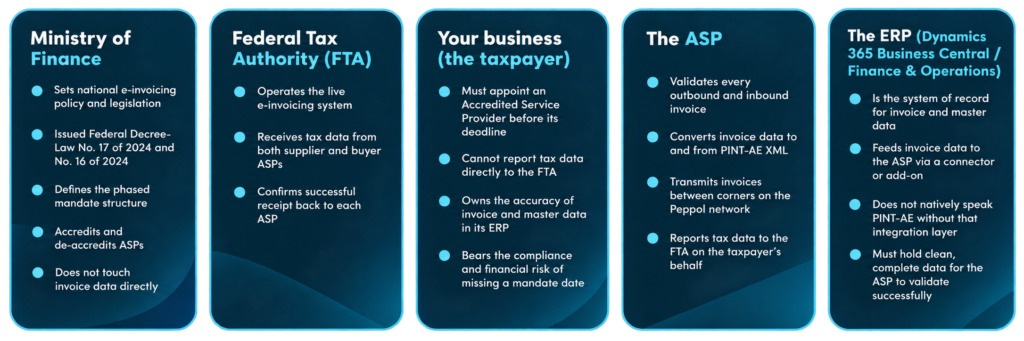
Five parties touch every UAE e-invoice. Each has one clear job — and confusing them is the most common cause of delayed compliance projects.
Policy-maker, operator, and taxpayer are three different roles
UAE e-invoicing responsibility is split cleanly across government and business, and it helps to separate the two regulators before looking at your own obligations. The Ministry of Finance (MoF) sets the legal and policy framework and accredits Accredited Service Providers (ASPs) — Federal Decree-Law No. 17 of 2024 on Tax Procedures, Federal Decree-Law No. 16 of 2024 on VAT, and Ministerial Decisions No. 243 and No. 244 of 2025 originate from this layer. The Federal Tax Authority (FTA) is the operator: it receives tax data and confirms receipt.
Your business sits below both: it must appoint an ASP, keep its ERP data accurate, and meet its mandate deadline. It is never a direct participant in the technical exchange with the FTA.
This is not a digitisation project you can opt out of on a timeline you choose. It is a legal mandate with fixed phases, fixed deadlines, and a defined technical standard.
What this means for your business
Who can you call when something goes wrong?
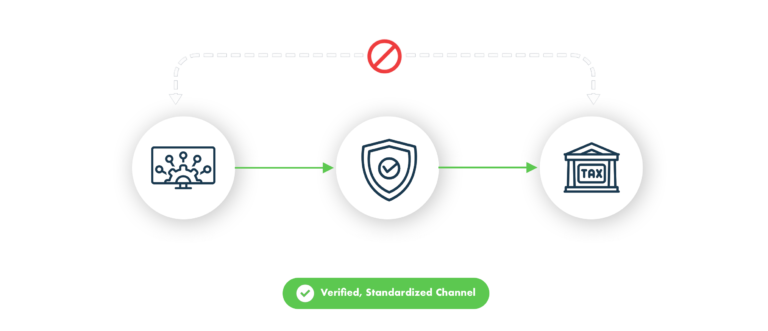
Why businesses cannot self-report
A recurring misconception is that a sufficiently sophisticated finance team could connect directly to the FTA and skip the ASP layer. Under the 5-corner model this is not permitted: every taxpayer, regardless of size or in-house technical capability, must route invoices and tax data through an Accredited Service Provider. The ASP layer is what allows the FTA to guarantee a single validated data standard (PINT-AE) across every business in the country, rather than reconciling inconsistent direct submissions.
Know your role — now check your readiness
Understanding who is responsible is step one. The next step is finding out whether your ERP and processes are actually ready to meet your part of the obligation.

Frequently Asked Questions
Does the Ministry of Finance handle day-to-day e-invoicing operations?
No. The Ministry of Finance sets policy and legislation and accredits ASPs; the Federal Tax Authority operates the live system and receives tax data.
Can my business report tax data to the FTA without ASP?
No. Every taxpayer must appoint an Accredited Service Provider — direct reporting to the FTA is not available to businesses.
Is my ERP vendor responsible for FTA compliance?
Your ERP (Dynamics 365 Business Central or Dynamics 365 Finance & Operations) is the system of record and must feed clean data to an ASP, but the ASP is the party accredited to validate, transmit and report on your behalf.
Who is accountable if an ASP loses its accreditation?
The MoF manages ASP accreditation, but your business remains responsible for having a compliant ASP in place — so a contingency plan for switching providers matters.
