

UAE E-Invoicing Knowledge Center
Dynamics 365 Finance & Operations: Built for Complex, Multi-Entity Enterprises
For large UAE-headquartered and regional organizations managing multiple legal entities, countries, or complex manufacturing and supply chain operations, Dynamics 365 Finance & Operations delivers the financial control, group-wide visibility, operational depth, and scalability required to support PINT-AE readiness across the enterprise.
Where Finance & Operations fits
Dynamics 365 Finance & Operations is built for large, complex organizations: multiple legal entities, operations spanning the UAE and other countries, and finance functions that need real-time multi-currency consolidation across the group. If your business runs discrete or process manufacturing, multi-warehouse supply chain operations, or intercompany transactions across several jurisdictions, Finance & Operations is designed for that scale of complexity.
It combines advanced financial management with integrated supply chain and manufacturing capabilities, and can be extended with Dynamics 365 Project Operations, Human Resources, Power Platform, and other Microsoft business applications.
Native localization strengths
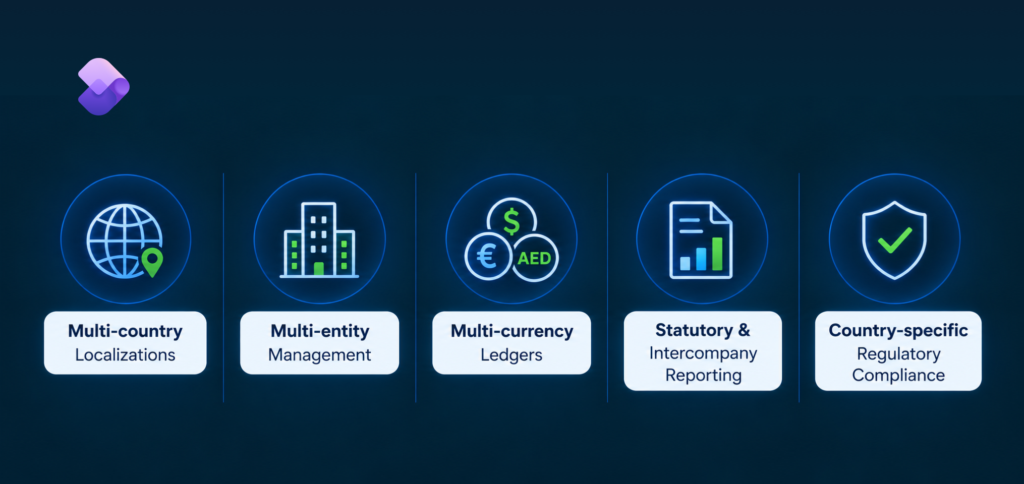
Finance & Operations supports UAE localization together with country-specific localizations for many other jurisdictions, enabling multi-entity VAT configuration, statutory and intercompany reporting, multi-currency ledgers, and country-specific regulatory requirements across the markets in which a group operates — all managed centrally rather than entity by entity.
As with Business Central, native localization covers domestic and regional statutory compliance, but not PINT-AE e-invoicing itself. Under Federal Decree-Law No. 17 of 2024 (Tax Procedures), Federal Decree-Law No. 16 of 2024 (VAT), and Ministerial Decisions No. 243 and No. 244 of 2025, the UAE’s 5-corner, Peppol-based e-invoicing model requires businesses and transactions within scope to use an MoF-accredited Accredited Service Provider (ASP) in the transmission path. Regardless of the ERP platform used, Finance & Operations cannot exchange compliant electronic invoices or report the required tax data directly to the Federal Tax Authority (FTA), and therefore requires integration with an accredited ASP.
How PINT-AE compliance is added: the ASP connector
Finance & Operations connects to PINT-AE compliance through an ASP connector or another supported integration framework, configured to map UAE invoice data to the PINT-AE XML format. For UAE legal entities, the connector converts invoice data generated by Finance & Operations into PINT-AE XML, then routes it to your Accredited Service Provider (ASP) for validation, transmission, and reporting of the required tax data to the Federal Tax Authority (FTA).
In the 5-corner flow, your ASP transmits the electronic invoice to your buyer’s ASP. The supplier’s ASP reports the required tax data to the FTA, while the buyer’s ASP validates the invoice, returns the appropriate status message, and reports the required tax data following successful validation. Status confirmations are then relayed through the ASPs back to both trading parties. At enterprise scale, this process must work consistently across every legal entity, currency, and jurisdiction in the group — which makes ASP selection, field mapping, integration design, and testing materially more involved than for a single-entity deployment.
Because different legal entities may fall into different implementation phases depending on their applicable revenue thresholds, coordinating a single group-wide ASP integration strategy is one of the most common gaps a readiness assessment uncovers.
Typical deployment path

Enterprise readiness assessment
Map PINT-AE fields for UAE entities and coordinate country-specific e-invoicing requirements for entities in other jurisdictions. Determine which entities and transactions are within scope, confirm the applicable implementation phase, and identify ERP, data, and ASP readiness gaps.

Financial and operational design
Configure the enterprise data model: chart of accounts, intercompany rules, multi-currency consolidation, and country-specific VAT setup.

ASP connector integration and testing
Integrate the ASP connector across entities, map PINT-AE fields per jurisdiction, and run structured test transmissions.

Phased rollout and cutover
Stage go-live by entity or region, run parallel validation, then cut over each entity ahead of its individual mandatory go-live date.
Why Finance Leaders Choose Finance & Operations
Finance & Operations balances growth, governance, and operational complexity across large organizations.
- Optimized ERP TCO at enterprise scale through a single platform for finance, operations, manufacturing, and supply chain management.
- Centralized financial control across multiple legal entities, business units, and jurisdictions.
- Real-time group-wide visibility into profitability, cash flow, working capital, and performance.
- Faster consolidation and close processes across entities, currencies, and reporting structures.
- Reduced compliance risk through centralized governance, localization, and a structured path to PINT-AE compliance.
- Integrated planning and execution across finance, procurement, inventory, manufacturing, and supply chain operations.
- Scalable governance and standardized processes across entities, regions, and business units while maintaining local operational requirements.
- Maximum value from Microsoft investments through seamless integration with Microsoft 365, Power BI, and Copilot.
Typical Dynamics 365 Finance & Operations customer profile
What scale demands

Months to 1+ year
Typical implementation timeframe for multi-entity, multi-country deployments
Enterprise/tiered
30 Oct 2026
Licensing model
The Dynamics 365 Finance & Operations licensing model aligns with enterprise requirements and is structured around users, functional roles, and business capabilities. This allows organizations to deploy the functionality each business unit requires while maintaining centralized governance across the group.
Finance & Operations is typically selected by organizations that require advanced financial management, multi-entity governance, manufacturing, supply chain, and consolidation capabilities across the enterprise.
ASP connector licensing and transmission fees sit on top of the Finance & Operations license and are typically based on invoice volume across the whole group.
The ASP connector and e-invoicing transmission services are licensed separately from Business Central, with pricing typically based on invoice volumes or tiered transaction packages offered by the accredited ASP you choose.
Is Dynamics 365 Finance & Operations the Right Choice?
If instead you run a single entity or a small number of related entities with standard UAE VAT and PINT-AE compliance needs, Business Central is typically the faster and more cost-effective fit. See Is Dynamics 365 Business Central the Right Choice? on the Business Central page
Who Finance & Operations is not right for
Finance & Operations is not the right starting point for small or single-entity businesses with straightforward compliance needs. Its depth in manufacturing, supply chain, and multi-entity consolidation comes with a licensing and implementation footprint that is disproportionate for a business that simply needs to issue and receive compliant PINT-AE invoices from one or two entities.
If your organization operates as a single legal entity, or a small number of closely related entities, in a single jurisdiction with standard VAT and compliance requirements, Dynamics 365 Business Central will get you to compliance faster and more efficiently, avoiding the overhead of capability you won’t use.
If your organization has outgrown a single-entity structure, operates in several markets, or runs sophisticated manufacturing and supply chain processes, Dynamics 365 Finance & Operations is the platform built for that scale.
Coordinating e-invoicing across multiple entities?
Book a Readiness Workshop with ATS consultants to map every entity in your group against its mandate phase and build a coordinated ASP and platform strategy.

Frequently Asked Questions
Does Finance & Operations generate PINT-AE e-invoices natively?
No. Like every ERP, Finance & Operations requires an ASP connector to convert, validate, and transmit PINT-AE invoices — direct reporting to the FTA is not possible without an accredited ASP.
How long does a Finance & Operations e-invoicing deployment take?
For multi-entity, multi-country groups, deployment typically runs from several months to over a year, depending on entity count, data readiness, and phased rollout scope.
Can each entity in a group go live on a different date?
Yes. Each legal entity’s mandate phase depends on its own revenue, so a phased, entity-by-entity rollout is common and often necessary.
Can existing Dynamics 365 Finance & Operations customers implement e-invoicing without replacing their ERP?
Yes. Existing Finance & Operations customers can implement PINT-AE e-invoicing through an accredited ASP connector without replacing their ERP. Finance & Operations remains the system of record while the ASP manages validation, transmission, and regulatory reporting.
How is Finance & Operations licensed?
Through an enterprise, tiered model based on named users, functional roles, modules, and entity scope, rather than a flat per-user subscription.
