

UAE E-Invoicing Knowledge Center
Is your ERP actually ready
for e-invoicing?
Readiness is not a single yes/no answer — it’s five specific dimensions of your Dynamics 365 environment. Most compliance delays trace back to one of them being overlooked.
"ERP readiness" is a specific, checkable state
When ATS talks about ERP readiness for UAE e-invoicing, we mean a defined, testable condition of your Dynamics 365 Business Central or Dynamics 365 Finance & Operations environment — not a vague sense of “we’ll be fine.” An ASP can only validate what your ERP sends it accurately and completely. If your master data, numbering, or integration layer has gaps, invoices will fail validation regardless of which ASP you appoint.
Readiness breaks down into five concrete areas, each worth auditing independently.
The five dimensions of ERP readiness
Master data quality
Every customer and vendor record needs an accurate Tax Registration Number (TRN), complete legal address, and correct tax classification. Missing or malformed TRNs are the single most common cause of invoice rejection.
Chart of accounts and tax code mapping
Tax codes in your ERP must map cleanly to the categories PINT-AE expects. Legacy tax code setups that predate VAT-era configuration often need remediation before they’ll validate.
Invoice numbering
Sequential, gap-free, uniquely identifiable invoice numbering is expected by the standard. Manual overrides, duplicate ranges, or multi-entity numbering clashes will surface as validation errors.
Integration and API readiness
Your Dynamics 365 environment needs a functioning connector to your Accredited Service Provider. This includes stable API access, correct field mapping, and a tested round trip for confirmations back into the ERP.
User process readiness
Finance and AR/AP teams need updated workflows for handling validation failures, exception invoices, and confirmation tracking — technology readiness without process readiness still produces delays.
Common readiness gaps and their downstream effect
Why this matters before you appoint an ASP
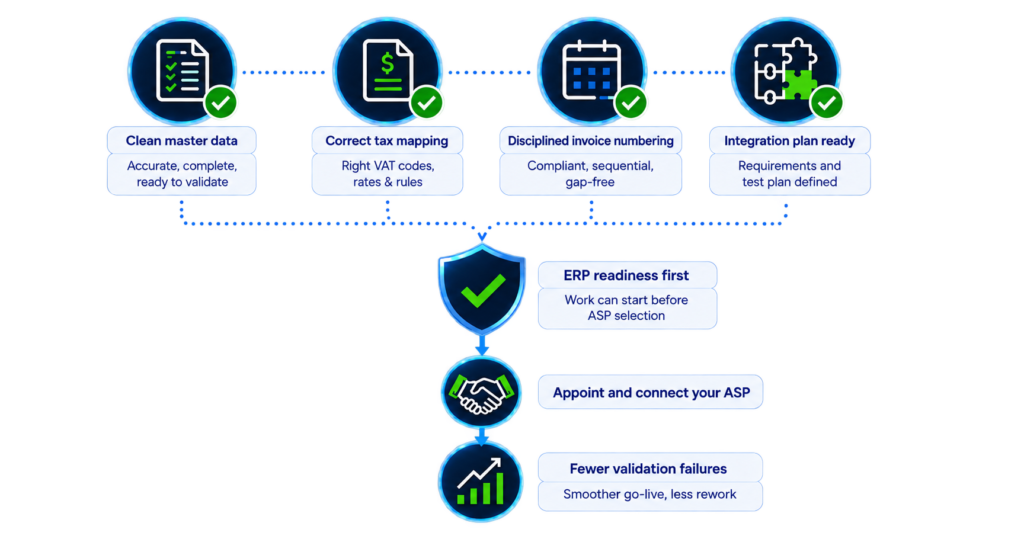
Businesses often assume ASP selection is the first step. In practice, an ERP with clean master data, correct tax mapping, disciplined invoice numbering, and a tested integration plan will get far more value from any ASP it appoints — and will avoid a wave of validation failures in the first weeks after go-live. Readiness work inside Dynamics 365 is largely independent of which ASP you eventually choose, so it can and should start now.
Find out where your Dynamics 365 environment stands today
A Readiness Workshop scores your master data, numbering, integration, and process readiness against the UAE e-invoicing mandate — and flags exactly where to focus first.

Frequently Asked Questions
What is the most common reason invoices fail validation?
Incomplete or incorrect customer and vendor Tax Registration Numbers (TRNs) are the most frequent cause of validation failure.
Does ERP readiness depend on which ASP I choose?
Largely no. Master data quality, tax code mapping, invoice numbering, and process readiness are ERP-side work you can start before appointing an ASP; only the final integration step depends on your ASP choice.
Can Dynamics 365 Business Central and Finance & Operations both reach full readiness?
Yes. Both platforms can be brought to full readiness for PINT-AE e-invoicing, though the underlying setup steps differ between the two products.
How long does ERP readiness work typically take?
It varies by data quality and entity complexity, but master data remediation and connector testing are the two workstreams most likely to extend the timeline if started late.
