

UAE E-Invoicing Knowledge Center
Dynamics 365 Finance & Operations: Built for Complex, Multi-Entity Enterprises
For large UAE-headquartered and regional organizations managing multiple legal entities, countries, or complex manufacturing and supply chain operations, Dynamics 365 Finance & Operations delivers the financial control, group-wide visibility, operational depth, and scalability required to support PINT-AE readiness across the enterprise.
Where Finance & Operations fits
Dynamics 365 Finance & Operations is built for large, complex organizations: multiple legal entities, operations spanning the UAE and other countries, and finance functions that need real-time multi-currency consolidation across the group. If your business runs discrete or process manufacturing, multi-warehouse supply chain operations, or intercompany transactions across several jurisdictions, Finance & Operations is designed for that scale of complexity.
It combines advanced financial management with integrated supply chain and manufacturing capabilities, and can be extended with Dynamics 365 Project Operations, Human Resources, Power Platform, and other Microsoft business applications.
Localization and built-in e-invoicing
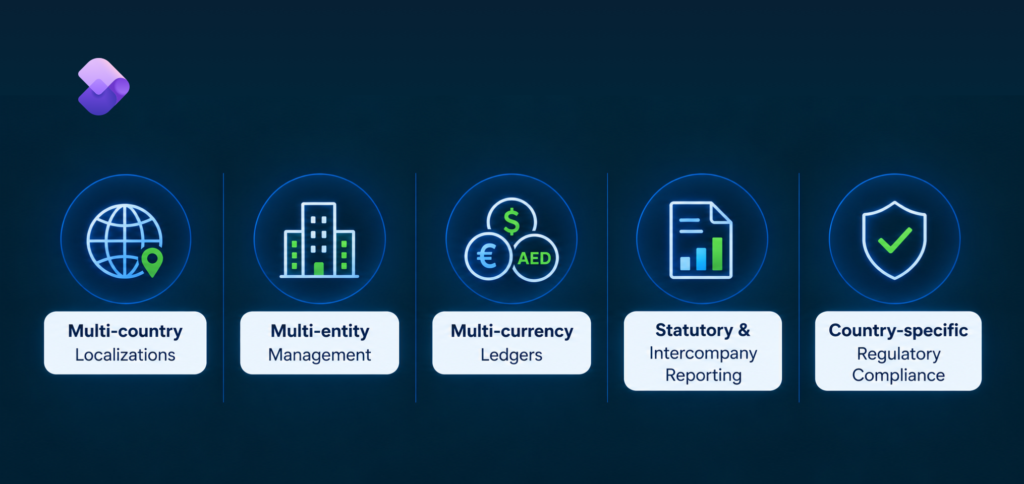
Finance & Operations supports UAE localization together with country-specific localizations for many other jurisdictions, enabling multi-entity VAT configuration, statutory and intercompany reporting, multi-currency ledgers, and country-specific regulatory requirements across the markets in which a group operates — all managed centrally rather than entity by entity.
Microsoft is adding built-in UAE e-invoicing to Dynamics 365 Finance. It went into public preview in July 2026, and general availability is planned for December 2026. The feature produces invoices and credit notes from sales orders, free text invoices and project invoices in the PINT-AE XML format, and sends them through the Peppol network.
Built-in support covers formatting, not delivery. Under Federal Decree-Law No. 17 of 2024 (Tax Procedures), Federal Decree-Law No. 16 of 2024 (VAT), and Ministerial Decisions No. 243 and No. 244 of 2025, the UAE’s 5-corner, Peppol-based model requires every in-scope invoice to go through an MoF-accredited Accredited Service Provider (ASP). No ERP, including Finance & Operations, can exchange compliant e-invoices or report tax data directly to the Federal Tax Authority (FTA).
How PINT-AE compliance works: built-in formatting plus your ASP
Finance & Operations either formats your UAE invoices in PINT-AE XML using Microsoft’s built-in UAE e-invoicing feature, or passes the invoice data to an ASP connector that converts it, depending on your version and setup.
In the 5-corner flow, your Accredited Service Provider (ASP) validates the invoice, transmits it to your buyer’s ASP and reports the required tax data to the Federal Tax Authority (FTA). The buyer’s ASP validates the invoice, returns the appropriate status message and reports the required tax data after successful validation. Status confirmations are then relayed through the ASPs back to both trading parties.
For groups, this process must work consistently across every UAE legal entity, while entities in other countries follow their own e-invoicing requirements. This makes ASP selection, field mapping, integration design and testing more involved than for a single-entity business.
What groups need to know
- Phases are based on revenue. Revenue means gross income for the most recent accounting period. Businesses with revenue of AED 50 million or more go live on 1 January 2027, and those below that go live on 1 July 2027, so entities in the same group may have different go-live dates.
- Invoices within a VAT group are temporarily exempt. Under Ministerial Decision No. 197 of 2026, transactions between members of the same VAT group don’t need e-invoicing for 24 months from 1 January 2027. Invoices to customers outside the VAT group are still in scope, and a Corporate Tax group is not automatically a VAT group.
- Holding companies may be in scope. A holding company that only earns passive income is generally out of scope, but recharging costs or management fees can bring it within scope.
- Free zone invoices may need more detail. Some free zone transactions may need to identify the ultimate beneficiary of a supply as well as the direct recipient.
In Finance & Operations, this means setting up intercompany invoicing to handle VAT group transactions separately during the exemption period, and checking that recharge and shared-service flows capture the right parties.
Typical deployment path

Enterprise readiness assessment
Determine which entities and transactions are within scope, including intercompany invoices covered by the temporary VAT group exemption, confirm each entity’s implementation phase, and identify ERP, data, and ASP readiness gaps. Coordinate country-specific e-invoicing requirements for entities in other jurisdictions.

Financial and operational design
Configure the enterprise data model: chart of accounts, intercompany rules, multi-currency consolidation, and country-specific VAT setup.

ASP connector integration and testing
Integrate the ASP connector across entities, map PINT-AE fields per jurisdiction, and run structured test transmissions.

Phased rollout and cutover
Stage go-live by entity or region, run parallel validation, then cut over each entity ahead of its individual mandatory go-live date.
Why Finance Leaders Choose Finance & Operations
Finance & Operations balances growth, governance, and operational complexity across large organizations.
- Optimized ERP TCO at enterprise scale through a single platform for finance, operations, manufacturing, and supply chain management.
- Centralized financial control across multiple legal entities, business units, and jurisdictions.
- Real-time group-wide visibility into profitability, cash flow, working capital, and performance.
- Faster consolidation and close processes across entities, currencies, and reporting structures.
- Reduced compliance risk through centralized governance, localization, and a structured path to PINT-AE compliance.
- Integrated planning and execution across finance, procurement, inventory, manufacturing, and supply chain operations.
- Scalable governance and standardized processes across entities, regions, and business units while maintaining local operational requirements.
- Maximum value from Microsoft investments through seamless integration with Microsoft 365, Power BI, and Copilot.
Typical Dynamics 365 Finance & Operations customer profile
What scale demands

Months to 1+ year
Typical implementation timeframe for multi-entity, multi-country deployments
Enterprise/tiered
31 March 2027
Licensing model
Dynamics 365 Finance & Operations apps, such as Finance and Supply Chain Management, are licensed per user, and the license type depends on each person’s role. Full users, such as finance controllers and supply chain leads, need a base license for their main app. Someone who also needs a second app, for example Finance and Supply Chain Management, adds a lower-cost attach license. Lighter users can use activity or team member licenses. Microsoft requires at least 20 full base licenses in total, so Finance & Operations is usually most cost-effective for larger organizations, while smaller entities tend to be better served by Business Central.
Finance & Operations is typically selected by organizations that require advanced financial management, multi-entity governance, manufacturing, supply chain, and consolidation capabilities across the enterprise.
ASP fees, plus any connector license if you use one, are charged on top of your Finance & Operations licenses. They are typically based on invoice volume across the whole group, depending on the ASP you choose.
Is Dynamics 365 Finance & Operations the Right Choice?
If instead you run a single entity or a small number of related entities with standard UAE VAT and PINT-AE compliance needs, Business Central is typically the faster and more cost-effective fit. See if Dynamics 365 Business Central is the Right Choice?
Who Finance & Operations is not right for
Finance & Operations is not the right starting point for small or single-entity businesses with straightforward compliance needs. Its depth in manufacturing, supply chain, and multi-entity consolidation comes with a licensing and implementation footprint that is disproportionate for a business that simply needs to issue and receive compliant PINT-AE invoices from one or two entities.
If your organization operates as a single legal entity, or a small number of closely related entities, in a single jurisdiction with standard VAT and compliance requirements, Dynamics 365 Business Central will get you to compliance faster and more efficiently, avoiding the overhead of capability you won’t use.
If your organization has outgrown a single-entity structure, operates in several markets, or runs sophisticated manufacturing and supply chain processes, Dynamics 365 Finance & Operations is the platform built for that scale.
Missed the 30 October deadline, or still have entities in Phase 2?
Phase 1 go-live is still 1 January 2027, and late implementation, including late ASP appointment, carries a penalty of AED 5,000 plus AED 5,000 for each further month, up to AED 50,000 in any 12 months. Book a Readiness Workshop with ATS. We’ll map every entity in your group to its phase, set your ASP and platform strategy, and plan go-live for each entity.

Frequently Asked Questions
Does Finance & Operations generate PINT-AE e-invoices natively?
Partly. Microsoft is releasing built-in UAE e-invoicing for Dynamics 365 Finance (public preview July 2026, general availability planned for December 2026). It formats invoices as PINT-AE XML. You still need an accredited ASP to validate and transmit each invoice and to report to the FTA. We’ll confirm whether your version supports the built-in feature or whether an ASP connector is the better fit.
How long does a Finance & Operations e-invoicing deployment take?
For multi-entity, multi-country groups, deployment typically runs from several months to over a year, depending on entity count, data readiness, and phased rollout scope.
Can each entity in a group go live on a different date?
Yes. Each business’s phase is based on its own revenue, so different go-live dates within a group are common. Transactions between members of the same VAT group are exempt for 24 months from 1 January 2027.
Can existing Dynamics 365 Finance & Operations customers implement e-invoicing without replacing their ERP?
Existing Finance & Operations customers can implement PINT-AE e-invoicing without replacing their ERP, using Microsoft’s built-in feature or an ASP connector together with an accredited ASP.
How is Finance & Operations licensed?
Per user, with the license type based on each person’s role: full, attach, activity or team member. Microsoft requires at least 20 full licenses. E-invoicing transmission fees from your ASP are charged separately.
