

UAE E-Invoicing Knowledge Center
Dynamics 365 Business Central for UAE E-Invoicing
Dynamics 365 Business Central is Microsoft’s global ERP for small and midsize businesses. For organizations operating a single legal entity or a small group of entities in the UAE, it combines robust financial management, native UAE localization, and lightweight ASP integration — one of the fastest paths to PINT-AE readiness that optimizes TCO without unnecessary enterprise complexity.
Where Dynamics 365 Business Central fits
Dynamics 365 Business Central is designed for small-to-midsize organizations worldwide: typically a single legal entity or a small handful of related entities. This page focuses on how it applies to businesses operating in the UAE. Business Central is typically the right choice for organizations operating a single legal entity or a small number of related entities with relatively straightforward financial, operational, and compliance requirements. Native localization reduces project risk because core UAE regulatory functionality is already supported without bespoke development.
It covers core financials, sales, purchasing, inventory, and basic project or service management out of the box, with UAE-specific VAT and statutory reporting already built into the localization pack. For companies at this scale, the goal is compliance and clean financial visibility without the overhead of a large enterprise platform.
Native localization strengths
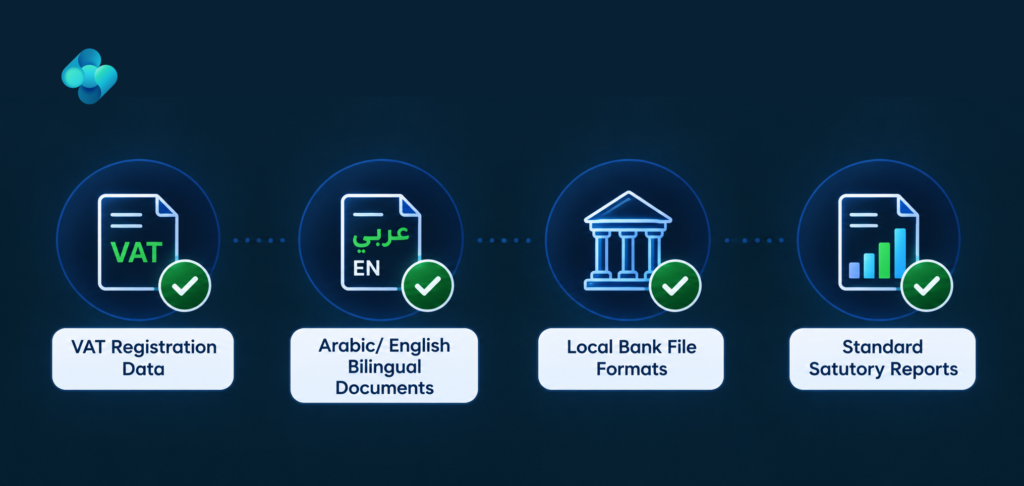
Business Central’s UAE localization handles VAT registration data, Arabic/English bilingual document layouts, local bank file formats, and standard statutory reports without custom development. This reduces the implementation burden significantly compared to configuring a generic international ERP for UAE requirements from scratch.
What the native localization does not include is PINT-AE e-invoicing itself. Peppol-based, 5-corner e-invoicing under Federal Decree-Law No. 17 of 2024 (Tax Procedures), Federal Decree-Law No. 16 of 2024 (VAT), and Ministerial Decisions No. 243 and No. 244 of 2025 requires a certified Accredited Service Provider (ASP) in the transmission path — no ERP, including Business Central, can report tax data directly to the Federal Tax Authority (FTA).
How PINT-AE compliance is added: the ASP connector
Dynamics 365 Business Central becomes PINT-AE compliant through integration with a Ministry of Finance (MoF)-accredited Accredited Service Provider (ASP). Depending on the ASP, the connection is typically provided via API-based integration. The connector has a focused role: it securely transfers invoice data from Business Central to the ASP, where it is transformed into the required UAE PINT-AE XML format and processed for regulatory compliance.
Once Business Central creates an invoice, the ASP validates it, converts it to the UAE PINT-AE XML format, securely exchanges it with the buyer’s ASP through the Peppol network, reports the required tax data to the Federal Tax Authority (FTA), and returns the processing status to Business Central. Finance teams continue working entirely within Business Central while the ASP manages the regulated exchange and compliance requirements behind the scenes.
Selecting the right ASP is only part of the equation. Ensuring your ERP produces complete, compliant invoice data—and validating how that data maps to the ASP—is often the most underestimated aspect of an e-invoicing project. A readiness assessment identifies these gaps early, reducing implementation risk and helping ensure a smoother path to PINT-AE compliance.
Typical deployment path

Readiness assessment
Confirm entity count, transaction volume, and current system gaps against your mandate phase and ASP requirements.

Core configuration
Set up or refine chart of accounts, VAT posting groups, and document layouts using the UAE localization.

ASP connector integration
Install and configure the ASP connector, map invoice fields to PINT-AE, and run test transmissions.

Go live
Run live and e-invoice paths side by side, validate confirmations, then go live ahead of your mandatory date.
Why Finance Leaders Choose Dynamics 365 Business Central
Business Central balances growth, compliance, and financial control without the complexity of a large enterprise ERP.
- Optimized ERP TCO through predictable subscription licensing and reduced implementation and administration overhead.
- Reduced compliance risk with UAE VAT localization, bilingual document support, and an efficient path to PINT-AE compliance.
- Stronger cash flow control with real-time visibility into receivables, payables, and liquidity.
- Faster financial close and reporting through centralized, real-time data and streamlined reconciliations.
- Less reliance on spreadsheets through integrated reporting and a single source of financial data.
- Real-time performance insights and confident decision-making backed by integrated analytics and Power BI reporting.
- Maximum value from Microsoft investments through seamless integration with Microsoft 365, Power BI, and Copilot.
- Simplified e-invoicing compliance through straightforward connectivity with accredited ASP providers.
Typical Dynamics 365 Business Central customer profile
Why speed and cost matter for this segment

Weeks, not quarters
Typical implementation timeframe for a single-entity deployment
Subscription licensing
Licensing model: pay per-user predictable costs, not a flat enterprise fee
2026 voluntary, 2027 mandatory
Phase 1 mandatory go-live for revenue ≥ AED 50M, Phase 2 businesses have until 1 Jul 2027
Licensing model
Business Central is licensed per user, with annual subscriptions typically providing the most cost-effective option. Licenses are generally split between full Essentials or Premium users, who require complete access to business processes, and lower-cost Team Member users, who need read access and light transaction capabilities. There is no large upfront platform fee, allowing organizations to scale users as the business grows while keeping the total cost of ownership predictable.
The ASP connector and e-invoicing transmission services are licensed separately from Business Central, with pricing typically based on invoice volumes or tiered transaction packages offered by the accredited ASP you choose.
Is Dynamics 365 Business Central the Right Choice?
If instead you operate many entities across multiple countries, require advanced manufacturing, need complex intercompany consolidation, manage large-scale supply chains, or have highly complex compliance requirements, see You should consider Dynamics 365 Finance & Operations on the Finance & Operations page.
Who Dynamics 365 Business Central is not right for
Business Central is not the right platform for very large organizations, groups with many legal entities across multiple countries, complex discrete or process manufacturing, or businesses that need deep multi-entity financial consolidation. Pushing that complexity into Business Central usually means heavy customization, reducing the agility and cost advantages that make it an attractive solution for growing businesses.
If your organization has outgrown a single-entity structure, operates in several markets, or runs sophisticated manufacturing and supply chain processes, Dynamics 365 Finance & Operations is the platform built for that scale.
Not sure which platform fits your business?
Book a Readiness Workshop to see where your business sits against the UAE e-invoicing timeline and get a platform recommendation aligned to your entity structure and compliance needs.

Frequently Asked Questions
Does Business Central generate PINT-AE e-invoices natively?
No. Business Central generates the underlying invoice data, but PINT-AE conversion, validation, and transmission require an ASP connector — no ERP can report directly to the FTA.
How long does a Business Central e-invoicing deployment take?
For a single entity with standard requirements, deployment typically takes weeks rather than quarters, though timelines depend on data readiness and ASP selection.
Can existing Dynamics 365 Business Central customers implement e-invoicing without replacing their ERP?
Yes. Existing Business Central customers can achieve PINT-AE compliance by integrating with an accredited ASP. The ERP remains the system of record while the ASP handles invoice validation, transmission, and reporting.
Is Dynamics 365 Business Central suitable for a multi-country organization?
Business Central is well suited to organizations operating a small number of legal entities across multiple countries. For larger or more complex groups requiring advanced financial consolidation, extensive intercompany processes, or broader international compliance capabilities, Dynamics 365 Finance & Operations is typically the more appropriate choice.
How is Business Central licensed?
Per user, with annual subscriptions typically providing the most cost-effective option across Essentials/Premium and Team Member tiers, and no large upfront platform fee. The ASP connector and e-invoicing transmission fees are licensed separately.
