

UAE E-Invoicing Knowledge Center
What is UAE e-invoicing?
UAE e-invoicing is a legal requirement to exchange structured, machine-readable invoices through a regulated network, with tax data reported to the Federal Tax Authority in real time. Here is what that means in practice.
The Legal Basis
UAE e-invoicing is established under Federal Decree-Law No. 17 of 2024 on Tax Procedures — which amends Federal Decree-Law No. 28 of 2022 — together with Federal Decree-Law No. 16 of 2024 amending the VAT Law, with implementation detail set out in Ministerial Decisions No. 243 and No. 244 of 2025. Together they require businesses to issue and receive invoices in a structured electronic format, rather than as PDFs, scanned images, or paper documents, and to have that data reported to the Federal Tax Authority (FTA).
This is not a digitisation project you can opt out of on a timeline you choose. It is a legal mandate with fixed phases, fixed deadlines, and a defined technical standard.
The Model: 5-corner, Built on Peppol
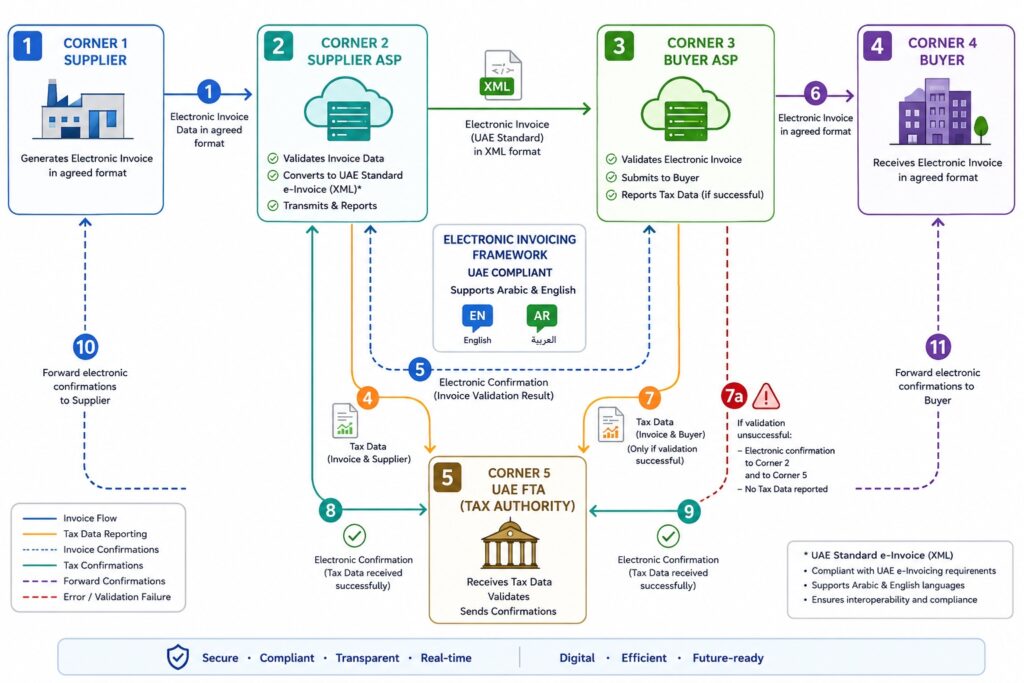
The UAE has adopted a 5-corner e-invoicing model based on Peppol, the international four-corner interoperability framework used across e-invoicing systems in Europe, Australia, Singapore and elsewhere — with a fifth corner added for direct government reporting.
The five corners are: the supplier, the supplier’s Accredited Service Provider (ASP), the buyer’s ASP, the buyer, and the FTA, which receives tax data from both ASPs in parallel. No invoice reaches its destination without passing through this chain.
The Data Standard: PINT-AE
Every e-invoice must conform to PINT-AE — Peppol International, UAE — the localized UAE data standard built on the Peppol International invoice specification. PINT-AE defines the exact structure, fields, and validation rules an invoice must meet before it can be transmitted and accepted.
This is a technical requirement, not a formatting preference. Dynamics 365 Business Central and Dynamics 365 Finance & Operations do not generate PINT-AE XML natively — both require ASP connectivity through an add-on or connector to validate, convert, and transmit compliant invoices.
Key facts at a glance
See exactly how the invoice flow works
The 5-corner model, step by step — from your ERP to your buyer’s ERP, with the FTA confirming receipt along the way.

What this means for your business
You need an ASP
Businesses cannot report directly to the FTA. An accredited ASP validates, converts, and transmits your invoices on your behalf.
Your ERP needs a connector
Dynamics 365 requires an add-on or connector to generate PINT-AE-compliant invoices and connect to your chosen ASP.
The clock is already running
Voluntary adoption opened 1 July 2026. Mandatory phases follow through to October 2027, with fixed ASP appointment deadlines before each go-live.
PDFs stop being valid
Once your mandate date applies, a PDF, scanned, or paper invoice is no longer an acceptable e-invoice under the law.
Frequently Asked Questions
What is PINT-AE?
PINT-AE (Peppol International, UAE) is the UAE’s localized e-invoice data standard, built on the Peppol International invoice specification, defining the structure and validation rules every e-invoice must meet.
What is the 5-corner model?
It is the UAE’s e-invoicing architecture: supplier, supplier’s ASP, buyer’s ASP, buyer, and the FTA, which receives tax data from both ASPs in parallel and confirms receipt back to them.
Is UAE e-invoicing the same as VAT invoicing today?
No. Today’s VAT invoices can be PDFs or paper. Under the mandate, invoices must be structured, validated PINT-AE files transmitted through an ASP — PDFs and paper are no longer valid once your mandate date applies.
Which law governs UAE e-invoicing?
Federal Decree-Law No. 17 of 2024 on Tax Procedures, alongside Federal Decree-Law No. 16 of 2024 on VAT, with implementation detail in Ministerial Decisions No. 243 and No. 244 of 2025.
Does Dynamics 365 support PINT-AE out of the box?
Not natively. Both Dynamics 365 Business Central and Dynamics 365 Finance & Operations require ASP connectivity via an add-on or connector to generate, validate and transmit PINT-AE-compliant e-invoices.
